Data Center UPS Battery Comparison: Lead-Acid vs Lithium-Ion
In modern data center infrastructure, ensuring continuous power availability is critical. Data center operators often face the decision between lead-acid and lithium-ion batteries. This choice goes beyond space considerations and involves important technical factors related to safety and performance. Understanding the differences between these two battery types can help enterprises optimize long-term total cost of ownership (TCO).
This article provides an in-depth comparison of lead-acid and lithium-ion batteries across key performance dimensions, helping you select the most suitable UPS solution.
What Are Data Center UPS Batteries? An Overview of Technology Evolution
Stable data center operations rely on uninterruptible power supply (UPS) systems. Traditionally, valve-regulated lead-acid (VRLA) batteries have been the industry standard. However, as lithium-ion (Li-ion) technology matures, industry focus has shifted toward comparing the safety and performance differences between lead-acid and lithium batteries in data center environments.
To build sustainable IT infrastructure, enterprises should not focus solely on initial purchase cost. According to research published in the academic journal Applied Energy [1], battery selection can directly impact overall energy efficiency, including Power Usage Effectiveness (PUE). In data center applications, lithium-ion batteries are increasingly replacing traditional lead-acid systems due to their performance advantages.
Related reading: Introduction to the Principles and Structure of UPS Systems
Key Performance Comparison: Lead-Acid vs Lithium-Ion Batteries
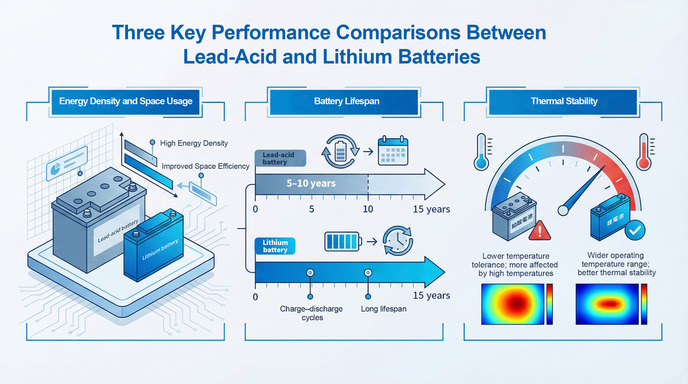
To build a high-performance data center, it is essential to understand the underlying characteristics of different energy storage technologies. Below is a comparison of lead-acid and lithium-ion batteries across three key dimensions:
1. Energy Density and Space Utilization
Energy density is a critical factor that directly affects data center layout and space planning.
- Lead-acid batteries: Lower energy density, requiring a larger number of battery cabinets to support extended backup durations. This leads to significant space consumption and increases data center infrastructure costs.
- Lithium-ion batteries: Typically offer 2 to 3 times the energy density of lead-acid batteries. For the same backup requirement, lithium-ion solutions can reduce footprint by up to 50 to 70 percent. This is especially valuable in space-constrained environments, allowing more room for revenue-generating server racks.
2. Battery Lifespan
Battery lifespan directly affects maintenance cycles and long-term asset depreciation.
- Lead-acid batteries: Although often rated for 5 to 10 years, performance can degrade significantly after 3 to 5 years in high-frequency charge and discharge environments typical of data centers, leading to more frequent replacements.
- Lithium-ion batteries: Offer strong durability, with a design lifespan of 10 to 15 years and a much higher cycle life. In many cases, they can align with the lifecycle of the UPS system itself, significantly reducing replacement and maintenance costs.
3. Thermal Stability
Thermal management is a key factor affecting both energy efficiency and operational safety.
- Lead-acid batteries: Highly sensitive to temperature. Optimal operating conditions must be maintained at around 25°C. For every 10°C increase, battery lifespan is effectively reduced by half. This requires continuous high-intensity cooling, which lowers overall energy efficiency.
- Lithium-ion batteries: Provide higher thermal stability and can operate reliably at elevated temperatures without structural degradation. This allows data centers to increase cooling setpoints, helping reduce PUE and support green data center initiatives.
Related reading: Learn more about Uninterruptible Power Supply Systems Solutions
Safety Considerations: Lead-Acid vs Lithium-Ion Batteries
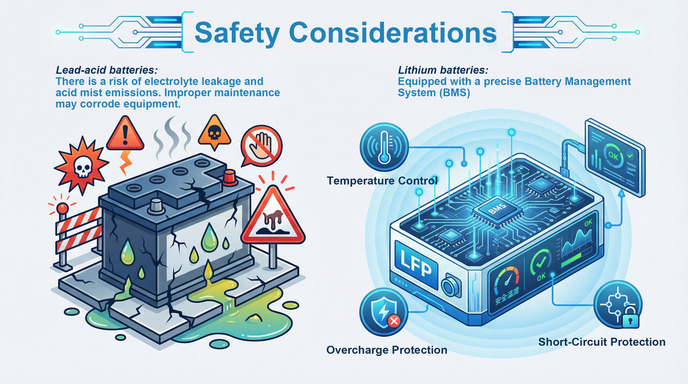
In terms of safety, both lead-acid and lithium-ion batteries are supported by well-established monitoring systems. Traditional lead-acid batteries do not typically pose a fire risk, but they carry potential issues such as electrolyte leakage and acid mist emissions. If not properly maintained, these can lead to equipment corrosion.
In comparison, modern data center lithium batteries, such as lithium iron phosphate (LFP), are equipped with advanced Battery Management Systems (BMS). A BMS continuously monitors the condition of each cell and can automatically disconnect the circuit in cases of overcharging, over-discharging, or abnormal temperature increases. This active protection mechanism enhances overall system reliability.
Cost and ESG: Moving Toward Sustainable Data Centers
From a total cost of ownership (TCO) perspective, lithium-ion batteries typically require higher upfront investment. However, due to their longer lifespan and lower cooling requirements, they can reduce overall costs by approximately 15 to 30 percent over a ten-year operating period.
In addition, lead-acid batteries contain heavy metals that can have significant environmental impact, as highlighted in studies such as those published in The Lancet Planetary Health [2]. Lithium-ion batteries, by contrast, align more closely with modern enterprise goals for green and sustainable IT infrastructure.
Newtech: Industry-Leading Data Center Experts
Newtech is committed to delivering professional data center solutions tailored to enterprise needs. With deep expertise in both lead-acid and lithium-ion battery systems, we help clients evaluate key safety and performance factors across planning, deployment, and maintenance stages to optimize energy efficiency.
Designing a data center requires balancing upfront investment with long-term value. Understanding the advantages of both battery technologies is essential for optimizing operations and making informed investment decisions. Whether your priority is stability or high performance, our team provides trusted technical support every step of the way.
Contact us to build a data center that meets your organization’s evolving requirements.
References:
- Applied Energy – Total Cost of Ownership (TCO) modeling for energy storage in data centers
- The Lancet Planetary Health – Global health effects of lead exposure and cardiovascular disease
- MDPI – Batteries – Comparative Techno-Economic and Life Cycle Assessment of Stationary Energy Storage Systems: Lithium-Ion, Lead-Acid, and Hydrogen
- IEEE Transactions on Industrial Electronics – Impedance-Based Battery Management System for Safety Monitoring of Lithium-Ion Batteries