Lithium Iron Phosphate Battery vs. Traditional Batteries: Advantages, Lifespan, and Safety Explained
When evaluating a backup power solution, businesses often spend considerable time determining which battery technology best meets their operational requirements. In recent years, Lithium Iron Phosphate (LFP) batteries have gained widespread attention in Uninterruptible Power Supply (UPS) systems, Battery Energy Storage Systems (BESS), and data centers due to their strong safety profile, long lifespan, and overall reliability.
But are LFP batteries truly more durable than traditional lead-acid batteries? This article explores the advantages and disadvantages of Lithium Iron Phosphate batteries, examines their lifespan and safety characteristics, and compares them with conventional battery technologies to help organizations identify the most suitable battery solution.
What Is a Lithium Iron Phosphate (LFP) Battery?
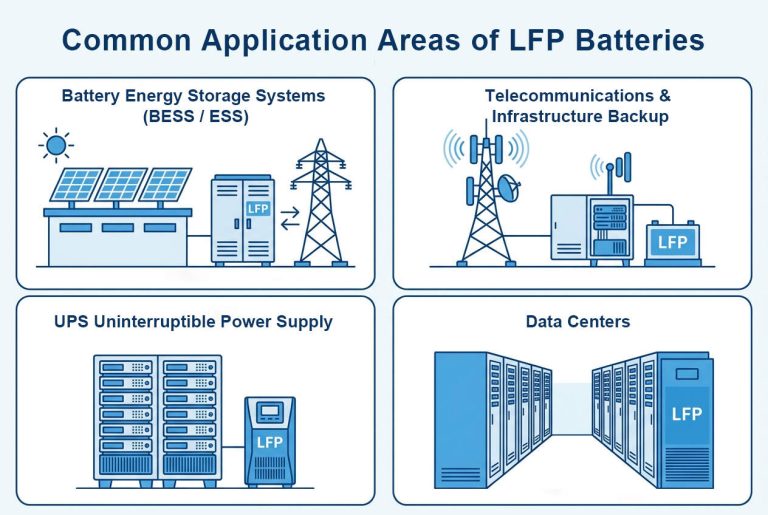
A Lithium Iron Phosphate (LFP) battery is a type of lithium-ion battery that uses lithium iron phosphate as its cathode material. Compared with other battery chemistries, LFP technology offers an excellent balance between cycle life, thermal stability, and cost-effectiveness, making it increasingly popular across modern energy infrastructure applications.
Common applications of LFP batteries include:
- Battery Energy Storage Systems (BESS / ESS): One of the most representative applications of LFP batteries. They are widely used in renewable energy integration, solar energy storage, grid frequency regulation, and backup power scenarios.
- Telecommunications and Infrastructure Backup: Commonly deployed in telecommunications facilities, network nodes, edge computing sites, and other mission-critical infrastructure that require continuous operation. These applications prioritize long service life, low maintenance requirements, and stable power output—all key advantages of LFP batteries.
- Uninterruptible Power Supply (UPS) Systems: Frequently used in server rooms, healthcare facilities, financial institutions, and industrial control environments to provide immediate and reliable backup power during outages.
- Data Centers: As demand for computing power continues to increase, data centers require backup power solutions that deliver greater reliability, longer lifespan, and improved space efficiency. Consequently, LFP batteries have become one of the preferred options for modern data center environments.
Further Reading: What Is the Average Lifespan of UPS Batteries? Introduction to the Principles and Structure of Uninterruptible Power Supply (UPS) Systems
What Are the Advantages of Lithium Iron Phosphate Batteries?
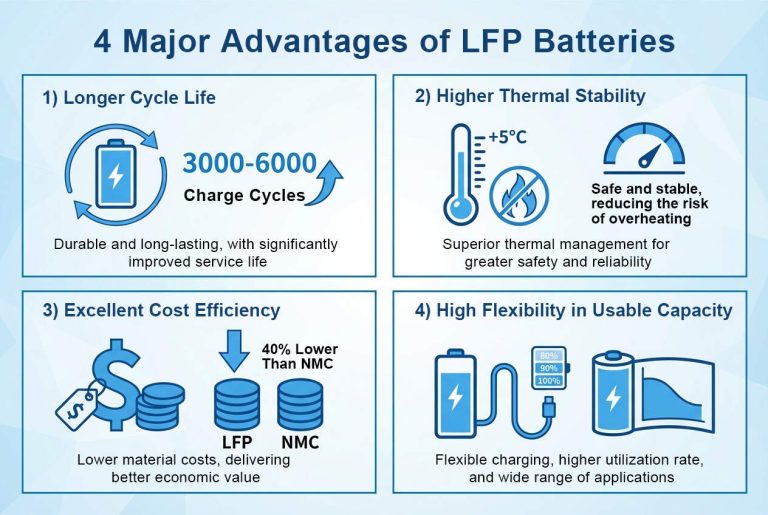
According to the International Energy Agency (IEA), LFP batteries account for more than 90% of global battery energy storage system deployments.[1] Their key advantages include:
1. Longer Cycle Life
One of the most significant advantages of LFP batteries is their extended cycle life. Under frequent charge and discharge conditions, they generally last longer than traditional lead-acid batteries, making them ideal for systems that require long-term, stable operation.
For UPS systems, energy storage applications, and data centers, a longer battery lifespan can help reduce replacement frequency and lower maintenance costs over time.
2. Higher Thermal Stability
Among various lithium battery chemistries, Lithium Iron Phosphate batteries are widely recognized for their excellent thermal stability.
According to the U.S. Department of Energy (DOE), one of the main reasons large-scale energy storage providers choose LFP batteries is their strong thermal stability, making them well suited for high-load environments, extended standby periods, and applications with stringent safety requirements.[2]
3. Strong Cost-Effectiveness
Another key advantage of LFP batteries is their competitive cost profile.
In 2025, the average price of LFP batteries is projected to be more than 40% lower than Nickel Manganese Cobalt (NMC) batteries, also known as ternary lithium batteries.[1] For organizations, this means lower upfront investment costs when deploying battery systems at scale or operating them over the long term.
4. Greater Usable Capacity Flexibility
Compared with many other lithium battery chemistries, LFP batteries offer greater flexibility in charging and operation. They can maintain stable performance even when operating near a full state of charge and are less susceptible to accelerated degradation caused by prolonged high charge levels.
For applications requiring a high degree of power availability, LFP batteries can provide greater usable capacity and improve overall system efficiency.
How Long Do Lithium Iron Phosphate Batteries Last? Understanding Their Durability and Safety
When evaluating whether to deploy LFP batteries in data centers, two of the most important considerations are battery lifespan and safety. Compared with traditional lead-acid batteries, LFP batteries generally offer superior durability and are highly regarded for their stable chemical structure.
LFP Battery Lifespan Compared with Traditional Batteries
According to a report from the U.S. Department of Energy, Lithium Iron Phosphate batteries typically achieve between 3,000 and 6,000 charge-discharge cycles at an 80% depth of discharge (DoD). In comparison, lead-acid batteries generally provide between 500 and 1,500 cycles.[3]
This means LFP batteries can deliver approximately three to eight times the cycle life of traditional lead-acid batteries, demonstrating greater durability in applications that require frequent charging and discharging.
For data centers and UPS systems, this difference in lifespan directly affects battery replacement schedules, operating costs, backup power reliability, and overall risk management strategies.
Safety Advantages of Lithium Iron Phosphate Batteries
The enhanced safety of LFP batteries stems primarily from their material composition and electrochemical characteristics.
Compared with certain lithium battery chemistries that contain higher levels of nickel, the cathode structure of LFP batteries is less prone to rapid decomposition at elevated temperatures and less likely to release oxygen that can intensify combustion. This helps reduce the risk of severe heat generation, thermal runaway, and fire.
Additionally, LFP cells generally approach thermal runaway conditions at higher temperatures. Even in the event of thermal runaway, the propagation rate is often slower than that of high-nickel NMC batteries. This provides system operators with more time to detect abnormal temperature increases, isolate affected components, and implement emergency response measures.
What Are the Disadvantages of Lithium Iron Phosphate Batteries?
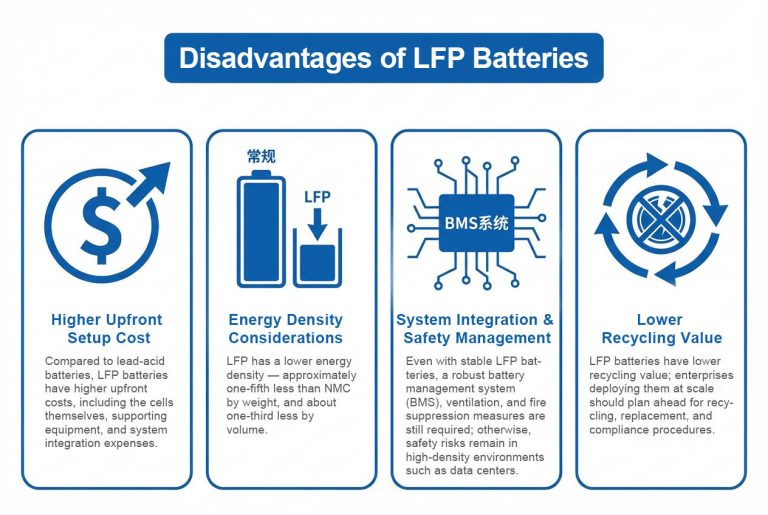
Although LFP batteries offer clear advantages in durability, stability, and overall cost-effectiveness, they are not necessarily suitable for every application.
Organizations should also understand the following limitations when evaluating battery solutions to determine whether LFP technology aligns with their operational requirements.
Higher Initial Deployment Costs
Compared with traditional lead-acid batteries, LFP battery systems generally require higher upfront investment. Costs may include the batteries themselves, supporting equipment, and system integration expenses.
While the longer lifespan, lower maintenance requirements, and higher efficiency of LFP batteries often reduce total cost of ownership over their lifecycle, businesses should still account for the higher initial capital expenditure.
Energy Density Considerations
Another limitation of LFP batteries is their energy density, which refers to the amount of energy that can be stored within a given weight or volume.
Research indicates that, for the same battery weight, LFP batteries typically offer approximately 20% lower energy density than NMC batteries. In terms of volume, the difference may be as much as one-third.[4]
As a result, applications with strict space or weight constraints may require additional evaluation when selecting a battery technology.
System Integration and Safety Management Requirements
Even when using Lithium Iron Phosphate batteries with superior thermal stability and safety characteristics, organizations must still implement a comprehensive Battery Management System (BMS).
Important considerations include charge current and voltage control, continuous monitoring mechanisms, installation environment design, and system-level protection strategies.
In other words, although LFP batteries are generally more stable, inadequate monitoring, ventilation, or fire protection measures may still introduce safety risks—particularly in high-capacity, densely deployed data center environments.
Lower Recycling Value
Compared with battery chemistries that contain larger quantities of nickel, cobalt, and other valuable metals, LFP batteries generally offer lower material recovery value during recycling.
While this does not make LFP batteries unsuitable for long-term use, organizations planning large-scale deployments should consider future recycling, replacement, and lifecycle management strategies, including partnerships with recycling providers and compliance with relevant environmental regulations.
Key Differences Between Lithium Iron Phosphate Batteries and Traditional Batteries
The table below summarizes the key differences, advantages, and disadvantages of Lithium Iron Phosphate (LFP) batteries and traditional batteries, helping businesses quickly compare their suitability across different applications:
| Comparison Criteria | Lithium Iron Phosphate Battery (LFP) | Traditional Battery (Lead-Acid / VRLA) |
|---|---|---|
| Common Applications | Widely used in Battery Energy Storage Systems (ESS/BESS), UPS systems, and data center backup power solutions | Commonly used in UPS systems, backup power applications, and traditional server room battery cabinets |
| Advantages | Longer cycle life, higher thermal stability, lower maintenance requirements, and has become the dominant technology in the large-scale energy storage market | Mature technology, lower adoption barrier, and generally lower upfront procurement costs |
| Disadvantages | Higher initial deployment costs; energy density is generally lower than some lithium battery technologies, such as NMC batteries, when comparing the same weight or volume | Larger footprint, heavier weight, shorter cycle life, and typically higher long-term maintenance and replacement requirements |
| Suitable Applications | Ideal for data centers and critical infrastructure environments that prioritize long-term operation, system reliability, and safety | Suitable for environments where budget is the primary consideration, power loads are relatively lower, or operational requirements are more traditional |
Enhancing Data Center Safety: Why Lithium Iron Phosphate Batteries Are Becoming the Preferred Choice
As organizations accelerate their digital transformation initiatives, expectations for backup power reliability, energy efficiency, service life, and operational safety continue to increase. As a result, Lithium Iron Phosphate batteries have become an important option for data centers, UPS systems, and Battery Energy Storage Systems (BESS).
When evaluating whether LFP batteries are suitable for a specific environment, organizations should carefully assess both their advantages and limitations to achieve the right balance between reliability, space efficiency, operational management, and deployment costs.
For businesses planning new data center projects or upgrading existing server room infrastructure, selecting the right battery backup technology is only one part of the equation. It is equally important to ensure seamless integration with the overall power infrastructure, cooling and ventilation systems, facility monitoring platforms, fire protection systems, and long-term operational strategies.
As a professional data center engineering provider in Hong Kong, Newtech offers one-stop data center infrastructure solutions, covering power distribution systems, Uninterruptible Power Supply (UPS) systems, cooling and ventilation, fire protection, facility monitoring, and the iNAV DCIM Data Center Infrastructure Management platform. We also support multinational organizations with standardized data center deployment solutions across multiple locations.
If you would like to further evaluate the feasibility of deploying Lithium Iron Phosphate batteries in your data center environment, feel free to contact Newtech. Our team is ready to help you build a reliable, future-ready infrastructure and stay ahead in the digital era.
References:
- IEA – Global battery markets are growing strongly – and so are the supply risks
- U.S. Department of Energy – Energy Storage Safety Strategic Plan
- U.S. Department of Energy – 2022 Grid Energy Storage Technology Cost and Performance Assessment
- IEA – Electric vehicle batteries