What Is a HEPA Filter? Understanding HEPA Filter Ratings and How They Work
As organizations advance their digital transformation initiatives, upgrade server rooms, and optimize critical infrastructure, power supply, precision cooling, fire protection, monitoring systems, and backup solutions are often among the top priorities. When planning cooling and ventilation systems, however, suppliers frequently emphasize the importance of integrating filtration systems with HEPA filters.
So, what exactly is a HEPA filter, and what do its ratings mean? This article explores the working principles of HEPA filtration and its applications in professional environments, helping organizations select the most suitable filter specifications when designing cooling and ventilation systems.
What Is a HEPA Filter and Where Is It Used?
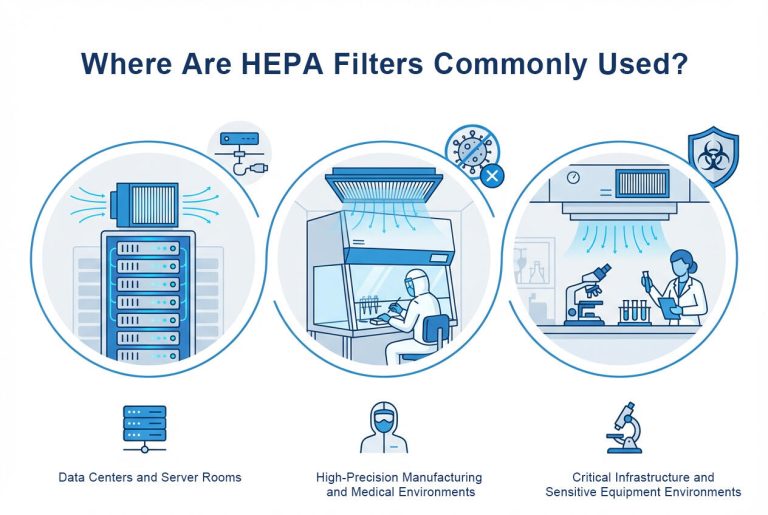
HEPA stands for High Efficiency Particulate Air filtration. While HEPA filters are commonly associated with air purifiers used in homes and commercial buildings, they are also widely integrated into cooling and ventilation systems in data centers and industrial infrastructure environments to remove airborne contaminants and particulate matter.
Common professional applications of HEPA filters include:
- Data Centers and Server Rooms: High-density IT equipment requires continuous and stable airflow. By integrating HEPA filtration into cooling and ventilation systems alongside precision cooling and temperature and humidity management, organizations can minimize the impact of environmental contaminants on system reliability.
- High-Precision Manufacturing and Healthcare Facilities: Cleanrooms commonly utilize HEPA filters to maintain stringent air cleanliness standards. From semiconductor packaging facilities to biopharmaceutical production environments, advanced filtration technologies provide a reliable barrier against airborne contamination.
- Critical Infrastructure and Sensitive Equipment Environments: Facilities such as power dispatch centers, telecommunications infrastructure, and financial data centers have very low tolerance for unplanned downtime. High-efficiency particulate air filters help reduce contamination risks introduced from the external environment.
How Does a HEPA Filter Work?
According to standards established by the U.S. Environmental Protection Agency (EPA), a HEPA filter must be capable of removing at least 99.97% of airborne particles measuring 0.3 microns (µm) in diameter.
A HEPA filter typically consists of densely packed pleated filter media, commonly made from glass microfiber due to its thermal resistance and stable physical properties. As air passes through the filter, the interwoven fiber structure captures contaminants through multiple filtration mechanisms.
Larger particles are directly trapped within the filter media. Medium-sized particles are intercepted through inertial impaction and airflow dynamics, causing them to collide with and adhere to the fibers. Ultrafine particles undergo random Brownian motion, increasing the likelihood of contact with the filter fibers, where they are subsequently captured.
When integrated into cooling and ventilation systems, HEPA filtration helps prevent dust and particulate matter from entering critical equipment, reducing the impact of contamination buildup on cooling performance and operational efficiency.
For data centers, server rooms, and other mission-critical environments, HEPA filters play an important role in maintaining system stability and extending equipment lifespan.
Understanding HEPA Filter Ratings: EN 1822 Classification Explained
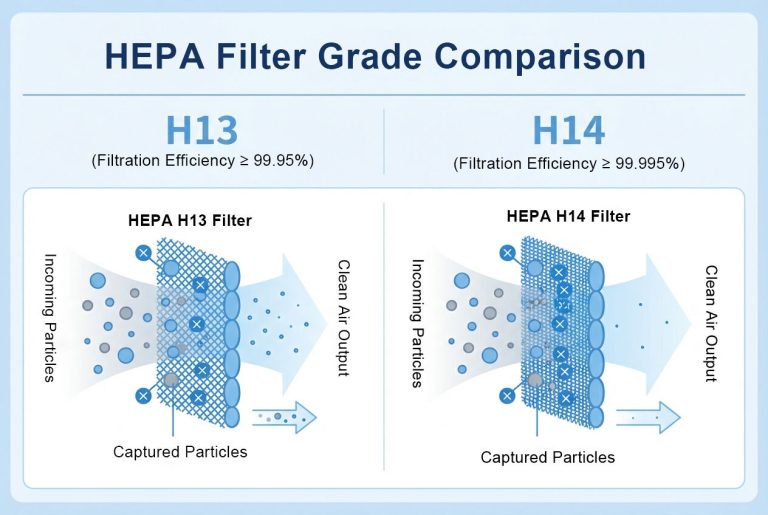
According to the EN 1822 international standard, high-efficiency air filters are categorized into three primary groups: E-Class (EPA), H-Class (HEPA), and U-Class (ULPA). These classifications are based on filtration efficiency against the Most Penetrating Particle Size (MPPS).
Among these categories, H13 and H14 HEPA filters are the most widely adopted filtration standards in data centers, server rooms, and critical infrastructure facilities.
H13 Rating
In precision environmental control applications, H13 filters are generally regarded as the professional-standard configuration, offering an overall filtration efficiency of ≥99.95%.
They effectively reduce the accumulation of micron-sized dust particles on high-density server circuit boards, helping to minimize the risk of equipment overheating or short circuits caused by dust buildup. As a result, H13 filters are widely recognized as a professional-grade filtration solution.
H14 Rating
Compared with H13 filters, H14 filters reduce particle penetration by approximately ten times, achieving an overall filtration efficiency of ≥99.995%.
This HEPA filter rating is typically used in environments with extremely stringent air quality requirements, such as advanced semiconductor manufacturing facilities, high-performance network operation centers, and other mission-critical environments where equipment is costly, heat loads are significant, and airflow cleanliness requirements are exceptionally demanding.
Is a Higher HEPA Filter Rating Always Better?
One common misconception when designing cooling and ventilation systems is that a higher HEPA filter rating automatically provides a safer environment. However, from both engineering and Total Cost of Ownership (TCO) perspectives, the ideal filter selection should balance cleanliness requirements, airflow resistance, and energy efficiency.
For example:
Balancing Filtration Efficiency and Airflow Resistance
As filter ratings increase—for example, from H13 to H14 or ULPA—the filter media generally becomes denser.
While this improves particle capture efficiency, it also increases initial pressure drop, meaning fans must consume more energy to push the same volume of air through the filtration system.
Selecting the Right Filter Based on Environmental Requirements
Rather than simply choosing the highest-rated HEPA filter available, organizations should select filtration solutions based on actual operational and environmental requirements.
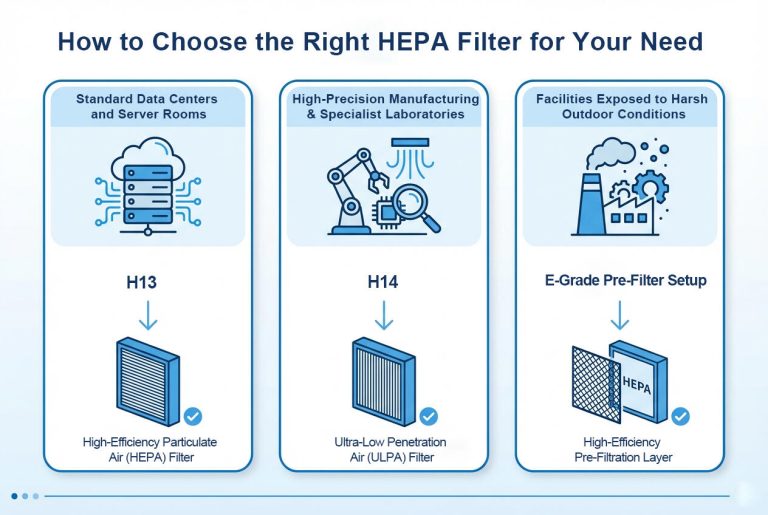
- Standard Data Centers and Server Rooms: H13 filters are generally recommended. Their filtration efficiency is sufficient for most IT environments while maintaining a favorable balance between airflow resistance and energy consumption.
- High-Precision Manufacturing and Specialized Laboratories: Environments involving semiconductor packaging, precision optics, biotechnology processes, or similar applications may require H14 or even ULPA filters to meet ISO cleanroom standards.
- Facilities Located in Harsh External Environments: For data centers located near industrial zones or areas with significant air pollution, a staged filtration strategy is recommended. Lower-grade filters, such as E-Class filters, can serve as pre-filters to reduce contaminant loads while balancing protection and operating costs.
HEPA Filter Maintenance Best Practices
HEPA filters are not permanent components. Over time, airborne particles captured by the filter gradually fill the spaces between fibers, increasing airflow resistance throughout the cooling and ventilation system.
If filters are not replaced when necessary, fans must operate at higher speeds to overcome the additional resistance. This can significantly increase data center energy consumption, negatively impact Power Usage Effectiveness (PUE), shorten fan lifespan, and potentially trigger equipment overheating alarms due to insufficient airflow.
How Often Should HEPA Filters Be Replaced?
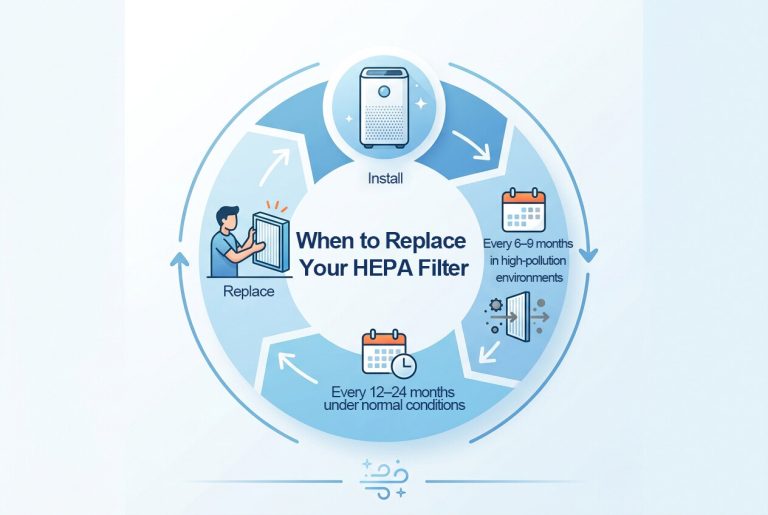
There is no universal replacement schedule for HEPA filters. The optimal replacement interval depends on environmental conditions, air circulation rates, and the effectiveness of upstream filtration systems.
As a general guideline:
- Systems with Effective Pre-Filtration and Intermediate Filtration Stages: Since larger contaminants are captured before reaching the HEPA filter, replacement is typically required every 12 to 24 months.
- Environments with Strict Cleanliness Requirements or Severe External Pollution: Replacement intervals may need to be shortened to approximately 6 to 9 months.
If a system bypasses pre-filtration stages and relies solely on high-efficiency HEPA filters to handle the entire incoming air load, filter lifespan can be significantly reduced. This not only increases consumable costs but may also expose critical equipment to greater operational risks.
Build a Reliable Infrastructure Environment with Newtech
In data centers and other critical infrastructure facilities, air quality management is a strategic factor that directly impacts equipment lifespan, energy efficiency, and operational reliability.
By understanding what HEPA filters are and how different HEPA filter ratings perform, organizations can incorporate both precision cooling and staged filtration strategies into their infrastructure planning from the outset. This approach can help optimize overall PUE performance while reducing Total Cost of Ownership (TCO).
If you are planning a server room upgrade, digital transformation project, or seeking professional environmental control solutions, contact Newtech today. Our team can help integrate HEPA filtration technologies into your data center cooling and ventilation systems, creating a more reliable, efficient, and sustainable operating environment for your business.
References:
- iTeh Standards / EN 1822-1:2019 – High efficiency air filters (EPA, HEPA and ULPA) – Part 1: Classification, performance testing, marking
- U.S. EPA – What is a HEPA filter?