Breaking Cooling Bottlenecks: What Is Direct Liquid Cooling (DLC)? Understanding Its Principles and Trends
For enterprises managing massive volumes of data, data center stability and energy efficiency are top priorities. With the explosive growth of artificial intelligence (AI) and high-performance computing (HPC), traditional air cooling technologies are no longer sufficient to handle the extreme heat density of modern processors.
For organizations pursuing peak performance, Direct Liquid Cooling (DLC) has emerged as a leading solution to address thermal challenges. This article provides an in-depth look at this transformative cooling approach, explaining how direct liquid cooling works, exploring its applications in AI data centers, and examining how it is becoming a backbone of modern green data center design.
Why Do AI Data Centers Need Direct Liquid Cooling?
Driven by generative AI and large language models (LLMs), server rack power density in data centers is reaching unprecedented levels. When the power consumption of a single rack exceeds 50 kW, traditional hot aisle/cold aisle air cooling approaches begin to hit their physical limits.
Direct liquid cooling stands out because liquids have significantly higher thermal conductivity than air. Since liquid can transfer heat approximately 25 times more efficiently than air, DLC can remove heat from critical components much faster within the same physical space.
For enterprises handling intensive workloads, adopting this cooling solution is not just about lowering temperatures. It is also essential for maintaining system performance by preventing processors from throttling under high computational loads, thereby ensuring stability and efficiency in AI operations.
How Direct Liquid Cooling Works: From Cold Plates to Heat Exchange
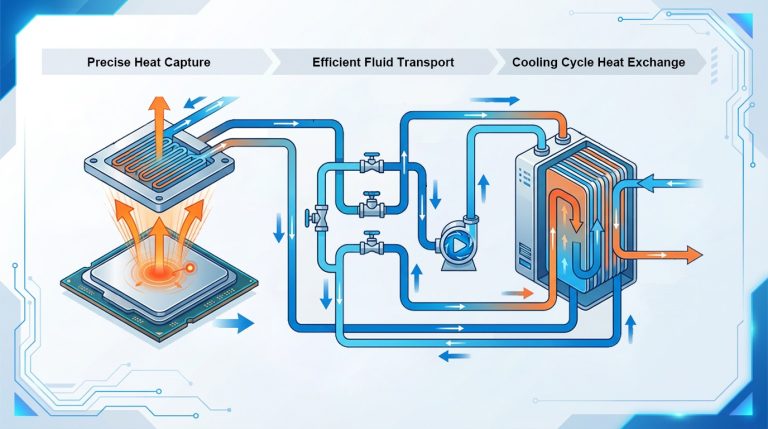
The key difference between direct liquid cooling and traditional cooling methods lies in its use of cold plate technology:
- Precise heat capture: Coolant flows through cold plates attached directly to CPUs or GPUs. With microchannel structures inside, heat is absorbed efficiently at the source.
- Efficient fluid transport: The heated liquid is collected through manifolds and transferred to a Coolant Distribution Unit (CDU).
- Closed-loop heat exchange: Acting as the core of the system, the CDU transfers heat from the internal liquid loop to the facility’s secondary cooling water system.
According to the second law of thermodynamics, liquids are more effective at minimizing the temperature difference between heat sources and cooling media. Compared to immersion cooling, where entire servers are submerged in liquid, direct liquid cooling requires fewer modifications to existing infrastructure and is easier to maintain, making it the preferred choice in enterprise environments today.
Three Key Advantages of Direct Liquid Cooling
Compared to traditional cooling methods, direct liquid cooling is not only a technological upgrade but also delivers long-term operational benefits for modern data centers.
1. Exceptional Cooling Efficiency
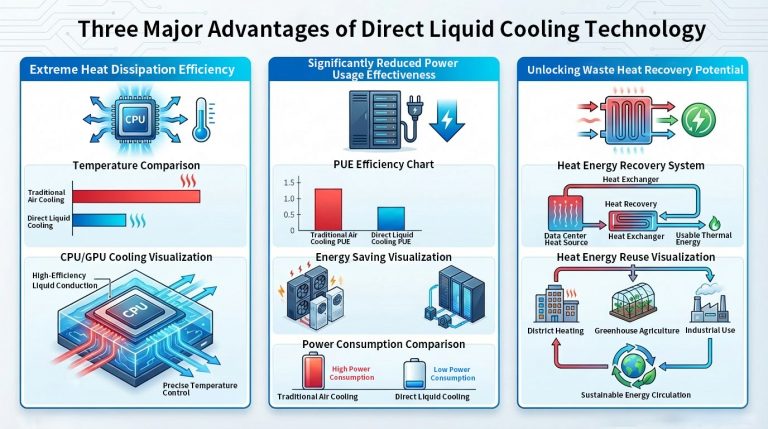
Traditional air-cooling systems rely on airflow, but air has very low thermal conductivity. Direct liquid cooling, on the other hand, uses highly conductive coolant to act directly on heat-generating components inside servers, such as CPUs and GPUs.
This approach significantly reduces the “thermal interface resistance” commonly found in air-cooling systems. Even during large-scale AI model training, when chips are operating at full capacity, temperatures can still be maintained within an optimal range. This not only supports higher-density computing but also helps extend the lifespan of costly IT equipment.
2. Significant Reduction in Power Usage Effectiveness
Power Usage Effectiveness (PUE) is the gold standard for measuring data center efficiency. Traditional data centers consume large amounts of electricity to power Computer Room Air Conditioning (CRAC) systems and high-speed rack fans.
Direct liquid cooling changes this dynamic. Since liquid circulation consumes far less power than fans and compressors, cooling energy consumption can be reduced by over 70%. This allows overall PUE to potentially drop to 1.15 or even lower, helping enterprises meet demanding AI computing needs while significantly reducing electricity costs and carbon footprint.
3. Enabling Heat Recovery Opportunities
Unlike low-grade waste heat produced by air cooling, the return liquid in direct liquid cooling systems typically maintains a higher and more stable temperature, usually around 45°C to 60°C.
This form of high-quality heat has strong recovery potential. Through heat exchange systems, it can be repurposed for building heating, hot water supply, or industrial processes. Under this circular economy model, data centers can evolve into part of a broader urban energy ecosystem, supporting ESG goals in energy efficiency and social responsibility.
Trends and Market Outlook: Becoming the Standard for AI Data Centers
As more large-scale AI models enter the inference stage, global demand for direct liquid cooling is expected to grow rapidly.
| Data Center Demand Trends | Future Development of Liquid Cooling |
|---|---|
| Hybrid architecture | Air cooling and direct liquid cooling will coexist, with DLC handling high-power chips while air cooling supports other components. |
| Component standardization | More server manufacturers will adopt “liquid-cooling ready” as a standard configuration. |
| AI-driven monitoring | AI algorithms will be used to predict coolant flow requirements and precisely match thermal loads. |
Building the Future of Green Data Centers with Direct Liquid Cooling
Direct liquid cooling has evolved from an experimental technology into a standard configuration for AI-era data centers. By understanding its principles, IT teams can effectively address overheating issues, extend equipment lifespan, and significantly improve energy efficiency.
Newtech is committed to delivering cutting-edge direct liquid cooling solutions. Our professional team can assess your existing data center environment and design a tailored liquid cooling integration strategy, helping your business balance computing performance with energy efficiency and operational costs.
Contact Newtech team to usher your data center into a new era that is quieter, more energy-efficient, and capable of supporting higher-density workloads.