How to Prevent Data Center Rooms From Becoming Too Hot or Too Cold? An Overview of International Temperature Standards and Control Practices
Server rooms are often described as the “heart” of an information system, responsible for processing, storing, and transmitting massive volumes of data. Beyond global cloud data centers, these facilities are also widely deployed in government departments, central banks, and network exchange hubs operated by telecommunications providers. Because these organizations require exceptionally high levels of system stability and data security, preventing temperature fluctuations, whether too high or too low, is likewise essential. What risks do temperature deviations create? How are such conditions regulated internationally? This article provides an overview of global temperature standards for server rooms and explains how maintaining proper environmental control helps prevent service disruption and equipment damage.
Why Maintaining Proper Server Room Temperature Matters
A stable and controlled environment is fundamental to the operation of any server room. When temperature levels fall outside acceptable ranges, both system stability and data integrity can be compromised.
Risks of Excessive Server Room Heat
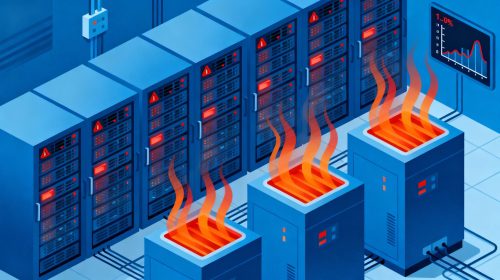
Prolonged exposure to high temperatures accelerates hardware degradation, triggers thermal throttling, and may even cause automatic system shutdowns. These issues reduce equipment lifespan and disrupt stable operation, potentially leading to data transmission failures or data loss. The impact can be severe especially for sectors like finance, healthcare, and telecommunications, where systems must operate with high reliability.
Hong Kong has experienced such incidents. In December 2022, a cooling system malfunction at the VDC data center caused a significant temperature spike, resulting in service outages at Alibaba Cloud Hong Kong Zone C. The disruption affected financial institutions, trading platforms, and numerous users across the city.
Risks of Excessive Cooling
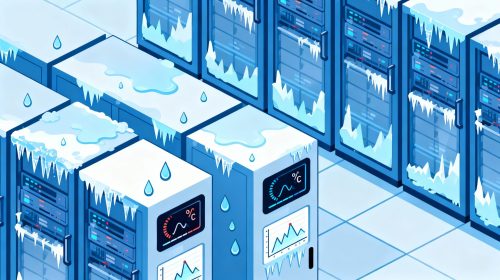
Temperatures set too low can create condensation, which may lead to short circuits and corrosion. Overcooling also wastes substantial energy. According to operational insights from the Chinese University of Hong Kong’s central ITSC, servers tend to issue persistent alerts when room temperatures are set unnecessarily low. In addition, excessive cooling increases energy consumption and runs counter to sustainability requirements. These cases demonstrate that adhering to proper temperature standards is essential to maintaining system stability and ensuring reliable service delivery.
International Standards for Server Room Temperature
Temperature control in server rooms is generally guided by the ASHRAE recommendations and the GB50174 national standard commonly used in mainland China.
1. ASHRAE TC 9.9 (widely adopted internationally)
- Full name: American Society of Heating, Refrigerating and Air-Conditioning Engineers, Technical Committee 9.9
- Scope: Focuses on environmental planning for data centers and electronic equipment, including recommended temperature and humidity ranges for server rooms.
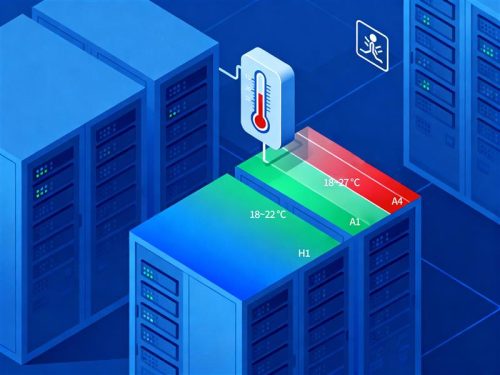
- Temperature range: Recommends operating data centers at 18°C to 27°C (dry bulb temperature).
- Classification system: Equipment is grouped into Class A1, A2, A3, A4, and H1 based on temperature tolerance. Each class provides a recommended range and an allowable range for reference.
- Class A2: Suitable for higher temperatures, with an upper limit of 35°C. Commonly used in cloud services and medium sized data centers.
- Class A3 and A4: Upper temperature limits of 40°C and 45°C respectively. Suitable for edge computing or equipment designed for high temperature environments.
- Class H1: Designed for high performance computing (HPC) and AI workloads. The recommended range is 18°C to 22°C, with allowable temperatures up to 25°C.
- Usage: ASHRAE TC 9.9 is widely regarded as the global reference standard for temperature control strategies, especially for cooling system and HVAC design.
2. GB50174 (National Standard in Mainland China)
- Full name: GB50174-2017 Code for Design of Data Centers
- Scope: Applies to the design, construction, and acceptance of data centers in mainland China.
- Temperature ranges by tier:
- Class A and B: 23°C ± 1°C
- Class C: 18°C to 28°C
- Usage: This is a mandatory standard with legal effect. Any data center built or operated in mainland China must comply with it.
Why Hong Kong Uses ASHRAE as the Reference Standard
In Hong Kong, commercial data centers typically follow the ASHRAE TC 9.9 temperature guideline of 18°C to 27°C to avoid overheating or overcooling during operation. Facilities then adjust within this range according to their tier and service requirements. For example, Tier IV data centers and financial data centers handling heavy compute workloads may set temperatures at 22°C ± 1°C.
The adoption of ASHRAE in Hong Kong is mainly due to the following reasons.
1. Consistency supports cross regional operations
Major global cloud providers such as AWS, Google Cloud and Microsoft Azure, along with local operators such as Vantage Data Centers and Equinix, use ASHRAE TC 9.9 as their design and operational reference. Using a unified standard supports centralized management across regions and ensures consistency between international cloud providers and local telecom operators.
2. Alignment with local climate and energy efficiency needs
Hong Kong has a subtropical maritime climate with consistently high temperature and humidity levels. Following the ASHRAE recommended temperature range of 18°C to 27°C helps maintain safe thermal conditions for equipment while also improving cooling efficiency. This contributes to better PUE (Power Usage Effectiveness) performance and supports both energy savings and sustainability goals.
3. Compatibility with other international standards
ASHRAE TC 9.9 aligns well with other globally recognized frameworks, including ISO 27001 for information security management, TIA-942 for data center facility design, and data center tiering systems. This compatibility allows multinational companies operating in Hong Kong to meet multiple compliance requirements and maintain international alignment.
How Server Room Types in Hong Kong Affect Temperature Standards
Different types of server rooms have varying service roles, equipment density and reliability requirements. Although Hong Kong generally follows the ASHRAE framework, the specific temperature settings vary according to the facility type. The common classification approach in Hong Kong is outlined below.
Classification by Service Model
1. Telecom Data Centers
- Purpose: Support core telecommunications infrastructure, including base station access, international submarine cable systems and cross border data exchange.
- Applications: Mobile network infrastructure, broadband network exchange centers and backbone network nodes.
2. Commercial Colocation Data Centers
- Purpose: Provide rack and cabinet rental services managed by the operator. Clients may deploy their own servers or rent hardware supplied by the provider, reducing the capital and manpower required to build their own facilities.
- Applications: Suitable for SMEs, multinational corporations, IT service providers and financial institutions. These facilities typically maintain strict security controls and monitoring.
3. Enterprise Data Centers
- Purpose: Built and operated internally by large enterprises, government departments and financial or insurance institutions. Used for internal system operations, data storage and backup to support daily operations.
- Applications: Banking platforms, government information systems and enterprise core systems such as ERP.
4. Hyperscale Data Centers
- Purpose: Provide the infrastructure for cloud computing, high performance computing, big data analytics and AI training. Usually operated by major technology firms or cloud service providers and designed to support massive storage and computational demands.
- Applications: Public cloud platforms, social networks, big data applications and AI development centers.
5. High Performance Computing and AI Data Centers
- Purpose: Designed for workloads with extremely high compute density and power consumption, including supercomputing, scientific modeling and AI model training.
- Applications: Government research institutions, AI research facilities and environments involving energy or climate simulations.
Classification by Reliability and Redundancy
Service reliability requirements differ across data center types, and these requirements directly affect temperature standards. The redundancy framework is defined by the Uptime Institute, which provides an internationally recognized certification for data center design. It evaluates availability, resilience and maintenance capability across four tiers.
1. Tier I Data Centers
- Single path for power and cooling with no redundancy. Any equipment failure results in downtime.
- Maintenance requires shutdown.
- Annual availability is approximately 99.671 percent, equivalent to around 29 hours of downtime.
2. Tier II Data Centers
- Partial redundancy for critical components such as UPS and cooling using an N+1 design.
- Still lacks the ability to perform maintenance without shutdown.
- Annual availability is approximately 99.741 percent, or about 22 hours of downtime.
3. Tier III Data Centers
- Multiple independent paths for power and cooling with N+1 redundancy.
- Supports maintenance without service interruption.
- Annual availability is approximately 99.982 percent, or about 1.6 hours of downtime.
4. Tier IV Data Centers
- Fully redundant 2N+1 architecture with physically isolated independent paths, resilient against single points of failure.
- Designed for continuous 24/7 uptime throughout the year.
- Annual availability is approximately 99.995 percent, or about 26.3 minutes of downtime.
Data Center Types and International Temperature Standards
| Data Center Type | ASHRAE TC 9.9 Recommended Temperature Range | Common Uptime Institute Tier Level |
|---|---|---|
| Telecom Data Centers | Recommended: 18°C to 27°C Permitted: 15°C to 32°C (Class A1) | Tier III or Tier IV |
| Commercial Colocation Data Centers | Recommended: 18°C to 27°C Permitted: 15°C to 32°C (Class A1) | Mainly Tier III, some facilities achieve Tier IV |
| Enterprise Data Centers | Recommended: 18°C to 27°C Permitted range depends on equipment class (A1 to A4) | Tier II or Tier III |
| Hyperscale Data Centers | Recommended: 18°C to 27°C (Class A1 or A2); Some facilities operate near the upper threshold (around 27°C) to improve PUE efficiency. | Primarily Tier III |
| High Performance Computing and AI Data Centers | Recommended: 18°C to 22°C (H1) Permitted: 15°C to 25°C | Tier III or Tier IV |
Temperature Control Methods
Whether it is a telecom data center, a commercial colocation facility, or an enterprise-built server room, maintaining temperatures within the ASHRAE TC 9.9 international standards and the requirements of the corresponding data center tier requires attention to several key areas.
1. Accurate environmental monitoring
- Install temperature and humidity sensors at the intake and exhaust points of each rack, connected to a central monitoring platform for unified management
- Configure alerts for overheating and abnormal conditions to ensure issues are detected and handled as early as possible
2. Airflow isolation and cooling redundancy
- Design cooling redundancy based on the data center’s tier level, such as N+1 (common in Tier III) or 2N (common in Tier IV), to keep temperatures stable during maintenance or single-point failures
- Conduct routine tests on backup cooling systems to confirm they can activate when needed and have not degraded due to long periods of inactivity
3. Dynamic temperature control
- Adjust cooling set points according to seasonal changes and equipment load. For example, 22°C to 24°C during summer and up to 25°C to 27°C during winter for better energy efficiency and lower PUE
- Follow the appropriate ASHRAE Class range (A1 to A4, H1) to avoid operating outside equipment tolerance limits
4. Adoption of advanced cooling technologies
- Use liquid cooling or immersion cooling for high-density computing zones to improve heat dissipation and reduce reliance on traditional air conditioning
- Some newly built data centers in Hong Kong have begun implementing free cooling, using lower outdoor temperatures in winter to support heat exchange and further optimise PUE
5. Regular maintenance and inspections
Routine upkeep is essential to ensure cooling performance remains stable. This includes:
- Cleaning air conditioning filters to prevent dust buildup that restricts airflow
- Inspecting refrigerant levels to ensure normal cooling performance
- Reviewing airflow paths and cable management to avoid obstructions caused by panels, cabling or equipment
- Testing redundant cooling systems (N+1, 2N) to ensure they can activate during maintenance or equipment failure
Professional Management of Data Center Temperature Control
In an era of rapid data growth and high-performance computing, standardised temperature management helps prevent issues caused by excessive heat or overly low temperatures, which can affect equipment performance and data stability. Following ASHRAE TC 9.9 guidelines, along with TIA-942 facility design standards and ISO 27001 security requirements, allows operators to reduce failure risks and maintain a secure, stable and efficient operating environment.
Achieving optimal performance requires more than hardware alone. Effective design planning, operational management and energy strategies are equally important. Newtech provides professional data center construction and smart green energy solutions, covering requirement analysis, design planning and ongoing temperature and energy optimisation. For inquiries related to data center setup or temperature control, you are welcome to contact us so we can help build a reliable and future-ready infrastructure for your organization.
References:
- DataCenterDynamics – PCCW data center refrigeration equipment failure causes Alibaba Cloud Hong Kong outage
- CUHK ISO – Data Centers Go Green: How CUHK Reduces Energy Consumption
- Uptime Institute – Tiers
- Dreamfly – 硬件問題:冷氣系統故障導致服務中斷
- IDCICP – 香港數據中心空調故障通知
- Henghost – 數據中心空調系統維護公告
- CSDN – ASHRAE 機房溫濕度標準詳解
- ASHRAE – Thermal Guidelines for Data Processing Environments – Quick Reference Card (5th Edition)
- CUHK ISO – 中大可持續校園:資料中心節能措施
- 能源園區 – 電信網路機房節能應用技術手冊