
[Data Center Power Distribution Revolution] What Is a Busway? Understanding Its Functions, Applications, and Flexibility Advantages in Modern Data Centers
As data centers move toward high-density computing and the widespread adoption of AI servers, traditional cable-based power distribution systems are increasingly unable to meet today’s demands for scalability and high-power loads. For IT managers and data center engineers, understanding what a Busway is and its practical applications can help build a more stable and scalable power infrastructure. This article provides a comprehensive overview of busway systems and explores their importance in modern infrastructure environments.
What Is a Busway? Definition and Structure of a Busway Power Distribution System
Before discussing data center power distribution, it is important to understand what a Busway is. Simply put, a Busway (also known as a Busduct) is a prefabricated, modular power distribution system that uses copper or aluminum busbars as conductors enclosed within a protective housing.
The Difference Between Busways and Traditional Cables
Compared with bundles of conventional cables, busways are rigid, prefabricated metal channels. Traditional cable distribution requires running large numbers of cables from switchboards to individual server racks, whereas a busway functions more like a “power highway,” allowing electricity to be tapped from any point along the track through plug-in boxes. This greatly simplifies wiring design and deployment.
Functions and Applications of Busways
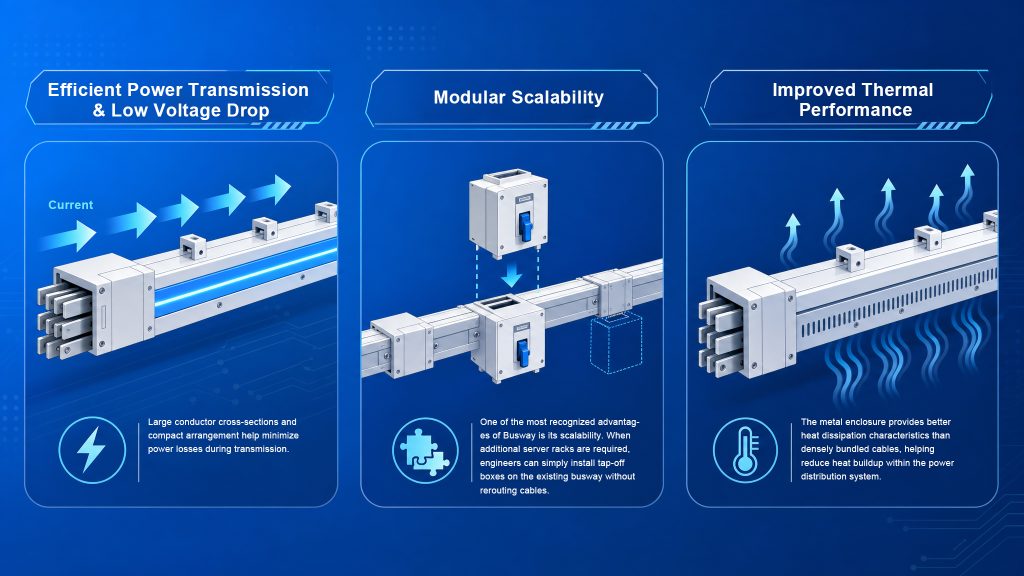
Before exploring busway applications, it is essential to understand their core functions. Busway systems were originally designed to replace traditional power distribution methods that are bulky and lack flexibility.
- Efficient Power Transmission with Low Voltage Drop: The large conductor cross-sectional area and compact arrangement help minimize energy losses during transmission.
- Modular Scalability: This is perhaps the most well-known advantage of busway systems. When additional server racks are required, engineers can simply install additional plug-in boxes onto the existing live busway track without rerouting cables.
- Improved Heat Dissipation: The metal enclosure offers excellent heat dissipation performance. Compared with densely bundled cables, busways can significantly reduce fire risks.
Real-World Applications in Hong Kong Data Centers
In many high-end data centers in Hong Kong, busway systems are widely deployed for overhead rack power distribution. Suspended installations free up valuable underfloor space, allowing Computer Room Air Conditioning (CRAC) systems to deliver airflow more efficiently. This flexibility enables facilities to upgrade or reconfigure power distribution without interrupting operations.
Busway vs Traditional Cable Systems: Key Advantages Comparison
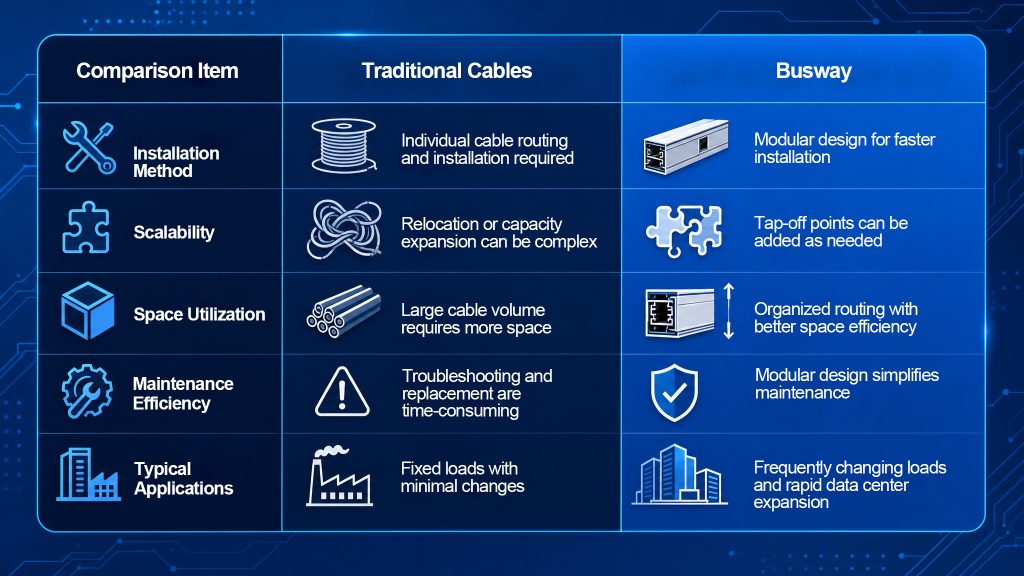
To better illustrate the value of busway systems, the following table compares busways and traditional cable solutions in data center environments:
| Comparison Item | Traditional Cables | Busway |
|---|---|---|
| Installation Method | Requires individual cable routing and extensive wiring work | Modular assembly design enables faster installation |
| Scalability | Relocating or adding loads is often complicated | Additional tap-off points can be added as needed |
| Space Utilization | Large volumes of cables consume significant space | Cleaner routing and improved space efficiency |
| Maintenance Efficiency | Troubleshooting and replacement can be time-consuming | Modular design simplifies maintenance |
| Ideal Applications | Fixed loads with minimal changes | Frequently changing loads and rapidly expanding data centers |
In high-density data center environments where rack positions and power demands frequently change, traditional cable systems often require extensive rewiring. Busway systems, by contrast, transform power distribution into a flexible and adaptable infrastructure component.
Key Considerations Before Deploying a Busway System
Before adopting a busway power distribution solution, organizations should conduct comprehensive planning and assessment. While busways offer significant advantages, the quality of upfront planning directly affects future maintenance costs and operational efficiency.
The following are three key evaluation areas:
- Accurately Assess Current Loads and Future Expansion Requirements: Evaluate current total power demand and reserve at least 20–30% additional capacity. Given the increasing power requirements of AI workloads, the value of busway systems lies in their ability to support higher branch densities and future rack expansion.
- Confirm Facility Layout and Site Constraints: Designs should account for ceiling height, rack arrangement, and maintenance access requirements. Since busways are prefabricated components, routing paths must avoid fire sprinkler systems and HVAC ductwork.
- Supplier Standards and Component Compatibility: Consider vendor specifications carefully. Although busway systems follow international standards, plug-in boxes from different manufacturers are generally not interchangeable. Selecting a system with comprehensive accessories and strong compatibility can prevent expansion challenges in the future.
Building Efficient Data Centers Starts with Understanding Busways
What is a Busway? It is not merely an alternative to traditional cabling, but a modern standard for power distribution architecture. Through the flexibility and functionality offered by busway systems, organizations can maximize power delivery efficiency within limited space while preserving the scalability needed for future IT expansion.
If you are planning to build or upgrade a data center, contact Newtech to learn more about busway functionality and how it can improve overall operational efficiency. Understanding the capabilities of busway systems is the first step toward making informed infrastructure decisions.
References:
- EATON – Fundamentals of low- and medium-voltage busway
- Ansys – 什麼是電氣匯流排?