Why Do Data Centers Need Hot and Cold Aisles? Principles and Applications of Aisle Containment
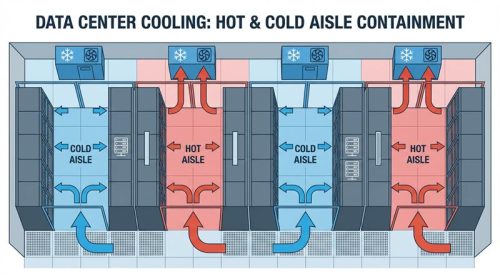
For enterprises managing large volumes of data, the stability and energy efficiency of data centers are top priorities. Among the many strategies for improving efficiency, the layout and containment of hot and cold aisles have become essential standard features in modern data centers. This article explores how hot and cold aisles operate, explains why aisle separation is critical, and provides practical strategies for improving airflow management to help IT managers optimize cooling performance and achieve better Power Usage Effectiveness (PUE).
What Are Hot and Cold Aisles? Understanding Airflow Management
Hot and cold aisles manage airflow by arranging server racks to prevent the mixing of cold and hot air. In traditional data centers without planned aisles, racks are often arranged in a “front-to-back” single-direction layout. This causes hot exhaust from one row to be drawn into the intake of the next row, leading to overheating and potential system failures. To compensate, air conditioning systems must lower temperatures excessively, wasting energy.
Standard Hot and Cold Aisle Layout
A standard data center aisle design uses a “front-to-front, back-to-back” configuration:
- Cold Aisle: The fronts of two rows of racks face each other, with cold air from raised floors or in-row cooling units filling the central aisle.
- Hot Aisle: The backs of two rows of racks face each other, collecting hot exhaust air and directing it back to the cooling system.
This separation ensures that server intakes always receive cool air, while hot exhaust is effectively removed.
Why Do Data Centers Need Aisle Containment?
Adjusting rack arrangement is just the first step. To maximize benefits, modern data centers emphasize aisle containment, which is a key focus for many Hong Kong enterprises improving their cooling efficiency.
1. Increase Cooling Capacity and Reduce PUE
Electricity costs in Hong Kong are high, and PUE (Power Usage Effectiveness) directly affects operational expenses. Without aisle containment, cold air may mix with surrounding hot air before reaching the racks, reducing cooling efficiency. Containment solutions, such as installing ceiling panels and aisle doors, force cold air to pass through server interiors before exiting. This allows air conditioning units to operate at higher temperatures, significantly lowering PUE and reducing costs.
2. Eliminate Bypass Airflow and Short-Circuiting
The most immediate benefit of hot and cold aisle improvements is the elimination of bypass airflow. In a contained system, cold air does not escape to non-cooled areas, ensuring it is used efficiently for server cooling. This is especially critical in high-density computing environments, effectively preventing hardware damage caused by localized overheating.
3. Extend Hardware Lifespan
Stable intake temperatures allow server fans to operate at lower speeds. With well-designed hot and cold aisle containment, temperature fluctuations inside servers are reduced, naturally extending the lifespan of electronic components and decreasing the frequency and cost of hardware replacement for enterprises.
Principles and Applications of Aisle Containment: Cold Aisle vs. Hot Aisle Containment
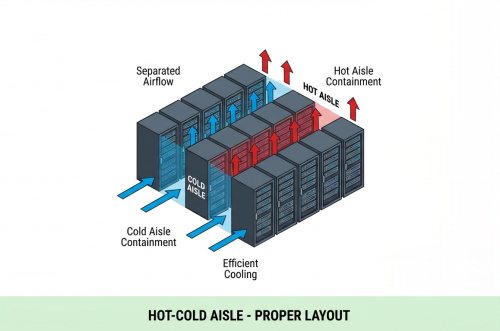
When improving data center hot and cold aisles, enterprises typically use either cold aisle containment or hot aisle containment. Each has its advantages and is suitable for different scenarios.
Cold Aisle Containment
This involves fully enclosing the cold aisle, essentially creating a “pool” of cold air.
- Principle: Cover the top of the cold aisle and install doors, keeping cold air concentrated in front of the racks.
- Advantages: Generally lower implementation cost; suitable for retrofitting older data centers.
- Disadvantages: The rest of the data center (outside the cold aisle) can become very hot, which is less comfortable for personnel working long hours in the room.
Hot Aisle Containment
This method channels hot exhaust directly through ducts or enclosed structures back to ceiling return vents.
- Principle: Enclose the hot aisle, allowing the remainder of the room to be filled with cold air.
- Advantages: Maintains a more comfortable overall room temperature and uses the room as a cold air buffer, providing more response time in case of air conditioning failure.
- Disadvantages: Higher construction cost, with specific requirements for ceiling height and return air paths.
Comparison Table: Cold vs. Hot Aisle Containment
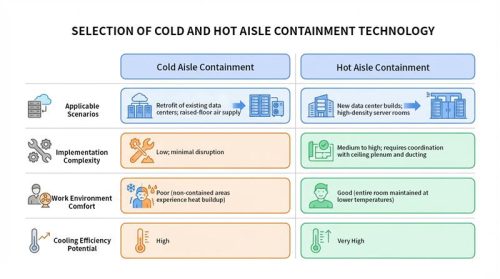
| Comparison | Cold Aisle Containment | Hot Aisle Containment |
|---|---|---|
| Suitable Scenarios | Retrofitting older data centers, raised-floor airflow | New data centers, high-density environments |
| Implementation Difficulty | Low, minimal disruption | Medium to high, requires ceiling duct coordination |
| Workplace Comfort | Poor (other areas get hot) | Good (entire room remains cooler) |
| Cooling Efficiency Potential | High | Very high |
For small to medium-sized enterprise data centers common in Hong Kong, if budgets are limited and major modifications to fire protection systems are undesirable, cold aisle containment is usually the first choice.
Key Considerations for Hong Kong Enterprises When Deploying Hot and Cold Aisles
Establishing hot and cold aisle systems in Hong Kong’s space-constrained environment requires careful planning. The following steps are recommended specifically for the Hong Kong context:
On-Site Assessment
Before purchasing any containment components, a thermal airflow analysis (CFD) of the existing data center should be conducted.
- Measure Air Leakage: Check the raised floor for unnecessary openings (e.g., cable pass-throughs), as these can cause static pressure loss.
- Confirm Airflow Direction: Ensure all server fans are oriented consistently.
- Check Fire Safety Restrictions: Hong Kong fire regulations are strict. Containing hot and cold aisles may affect gas-based fire suppression systems, so it may be necessary to install smoke vents.
Choosing Appropriate Containment Materials
To meet fire safety standards while allowing visibility, the following materials are commonly used in data center containment improvements:
- Tempered Glass or Polycarbonate: Used for ceilings and doors; they are durable, aesthetically pleasing, and transparent.
- PVC Strip Curtains: The most cost-effective option, but with lower airtightness and potential static buildup. They are increasingly less used in higher-end Hong Kong data centers.
- Intelligent Interlocking Doors: Connected to fire alarm systems; automatically open in case of a fire to allow suppression gas to enter the aisle.
The Importance of Blanking Panels
This is often the most overlooked aspect. If empty rack spaces (U positions) are not fitted with blanking panels, hot air will recirculate to the front. No matter how well the aisle containment is installed, the overall efficiency will be compromised without proper blanking. All unused U positions must be sealed to maintain airtightness.
Entrust Data Center Aisle Improvements to Professionals
Implementing an efficient containment system that complies with fire safety regulations requires an experienced partner. Newtech, as a leading critical infrastructure expert in the Asia-Pacific region, has over 30 years of industry experience, providing enterprises with one-stop data center solutions.
We understand that every data center’s layout and cooling challenges are unique. Whether you are planning a new hot and cold aisle setup or improving an existing one, contact the Newtech professional team. Through precise CFD thermal analysis, we can design a tailored containment and airflow management solution, helping you significantly reduce PUE and optimize operational costs.
References:
- ASHRAE – Mission Critical Facilities, Data Centers, Technology Spaces and Electronic Equipment
- The Green Grid – PUE™: A COMPREHENSIVE EXAMINATION OF THE METRIC
- TIA Standard: Telecommunications Infrastructure Standard for Data Centers