
Data Center Planning Essentials: Understanding Standard Rack Specifications, Server Rack Dimensions, and Layout Design
When planning a data center or upgrading a server room, one of the most common challenges enterprises face is a lack of understanding of standard rack specifications. Overlooking internationally recognized standards during the early design stage can lead to costly issues, such as servers failing to fit properly or even serious cooling problems.
As a professional data center solutions provider, we have observed that many clients often confuse standard rack dimensions with actual usable space when making purchasing decisions. This article breaks down the key concepts step by step, helping you determine the most suitable server rack size based on your equipment needs, avoid common deployment pitfalls, and ensure long-term operational stability.
What Is a Standard Rack? Understanding the 19-Inch Industry Standard
Before diving into specific dimensions, it is essential to understand the widely adopted EIA-310-D standard in the IT industry. A “19-inch rack” refers to the distance between the two internal mounting rails, which is 19 inches (approximately 482.6 mm).
This standard forms the foundation of most rack designs today. Whether it is rack servers from Dell, HPE, and Lenovo, or network switches from Cisco, the equipment is built to fit this width. Therefore, the first thing to confirm when selecting a rack is whether it complies with the 19-inch standard.
Rack Height: Understanding and Choosing the Right U Size
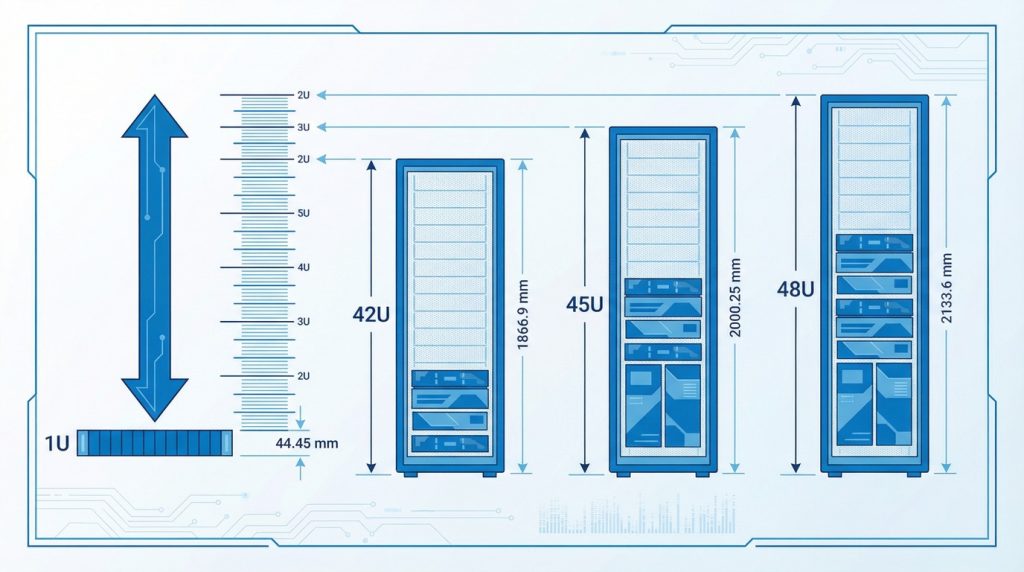
Rack height is not measured in meters or centimeters, but in units called “U.” One U equals 1.75 inches or 44.45 mm. Common rack height options include:
- 42U (mainstream choice): Approximately 2 meters in height. This is the most widely used option in commercial buildings and data centers, capable of supporting high-density IT deployments.
- 45U / 48U: Suitable for facilities with higher ceilings and requirements for maximum space utilization.
- 6U to 15U: Typically wall-mounted racks, ideal for small offices or branch locations with limited networking equipment.
It is recommended to reserve 20 to 30 percent of rack space for future expansion to avoid replacing the entire rack when adding new equipment.
Width and Depth: 600 mm vs 800 mm vs 1200 mm
When evaluating rack dimensions, many users focus only on height and overlook the importance of width and depth. These two factors directly affect cable management, airflow efficiency, and equipment compatibility, and are among the most commonly misunderstood aspects.
1. Width: The Key to Effective Cable Management
Although the internal mounting width is fixed at 19 inches, the external rack width typically comes in two options:
- 600 mm width: This is the most basic option, suitable for space-constrained environments. However, limited side clearance makes vertical cable management more difficult.
- 800 mm width: This design provides additional space on both sides for vertical cable management channels. For cable-intensive network environments, an 800 mm rack significantly improves airflow and overall organization.
2. Depth: Determining Whether Long-Form Servers Can Fit
Depth is the most critical factor when selecting a server rack. It is important to distinguish between external depth and usable depth.
- 600 mm – 800 mm depth: Typically suitable only for network switches or patch panels. Racks of this depth are often insufficient for modern standard rack servers.
- 1000 mm – 1200 mm depth: This is the mainstream configuration for modern, high-performance data centers. Today’s high-performance servers, especially those used for AI computing, are significantly longer in chassis design. Additional rear space is also required for airflow and for installing PDUs (Power Distribution Units). Therefore, racks with a depth of 1000 mm or even 1200 mm are strongly recommended.
Common Rack Types and Recommended Specifications
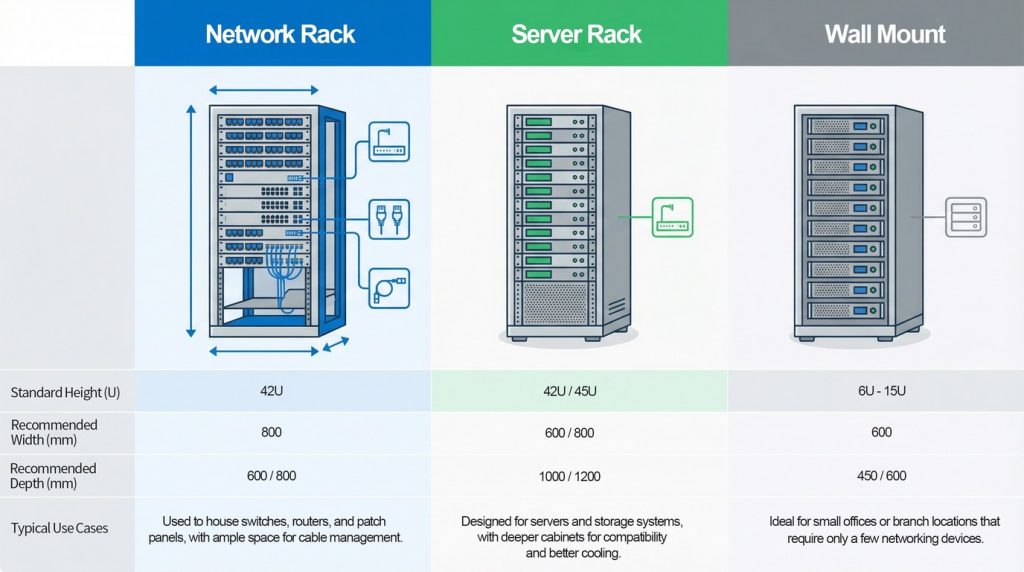
To provide a clearer overview, the table below summarizes recommended specifications for different use cases:
| Rack Type | Typical Height (U) | Recommended Width (mm) | Recommended Depth (mm) | Application |
|---|---|---|---|---|
| Network Rack | 42U | 800 | 600 / 800 | Used for switches, routers, and patch panels; requires ample cable management space |
| Server Rack | 42U / 45U | 600 / 800 | 1000 / 1200 | Used for servers and storage systems; focuses on depth compatibility and cooling |
| Wall Mount | 6U - 15U | 600 | 450 / 600 | Suitable for small offices or branch locations with minimal networking equipment |
Ensure Stable Data Center Setup with Standard Rack Compatibility
In summary, rack specifications should never be overlooked, as they directly impact the overall stability of your IT infrastructure. Only by adhering to standard rack specifications during the planning stage can you ensure ease of maintenance and future scalability.
Whether you need standard rack dimensions to house precision equipment, or are looking for specialized racks with depths of up to 1200 mm to support high-performance computing systems, professional guidance is essential. If you have any questions, feel free to contact our engineering team to build a reliable and future-ready data center foundation for your business.
We provide end-to-end data center solutions, from initial requirement analysis and design planning to temperature control and energy efficiency management. Get in touch with us to establish a robust and innovation-ready infrastructure for your data center.
References:
1. ECIA – EIA Technical Standards