High-Density IDC Explained: Understanding Its Definition, Applications, Advantages, and Deployment Requirements
Traditional data centers often struggle to accommodate high-density servers due to limited space, power supply, and cooling capacity. High-density IDC (High-Density Internet Data Center) has therefore become a key solution for enterprises looking to upgrade their infrastructure. This article explains what high-density IDC means, its various applications and requirements, and how its advantages can help enterprises strengthen their market competitiveness.
What Is a High-Density Data Center?
A High-Density Data Center, hereafter referred to as High-Density IDC, is a data center capable of supporting significantly higher power requirements within a single Rack compared with traditional standards.
What Is the Difference Between High-Density IDC and Traditional Data Centers?
-EN-1-768x432.jpg)
In a traditional IDC, the power density of a single rack typically ranges from 3kW to 10kW. High-Density IDC significantly exceeds this limit:
- Traditional IDC: Approximately 3kW–10kW per rack
- High-Density IDC: Typically 20kW–40kW or more per rack. For AI training and supercomputing centers, this can be scaled to 80kW–100kW+
Simply put, High-Density IDC enables more high-performance computing equipment, such as GPU servers, to be concentrated within a smaller physical footprint, creating a data center architecture that delivers “more computing power in less space.”
What Are the Main Applications and Use Cases of High-Density IDC?
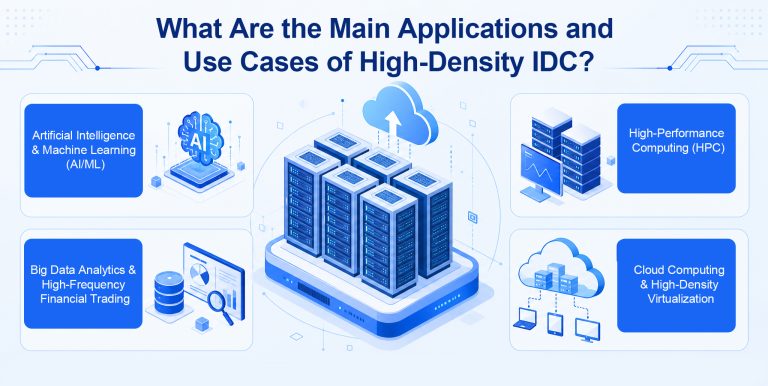
An increasing number of enterprises are adopting High-Density IDC, primarily because its applications can support the following high-computing-power requirements:
- Artificial Intelligence and Machine Learning (AI/ML): Deep learning models, such as Large Language Models (LLMs), require thousands of GPUs to work together. High-Density IDC provides the stable power supply and high-speed interconnectivity required between servers.
- High-Performance Computing (HPC): Used in scenarios requiring substantial parallel computing capabilities, including scientific research, weather simulation, and gene sequencing.
- Big Data Analytics and High-Frequency Financial Trading: Processes massive volumes of real-time data while requiring extremely low latency and high processing throughput.
- Cloud Computing and Extreme Virtualization: Cloud Service Providers (CSPs) can improve server consolidation and optimize infrastructure utilization through high-density racks.
4 Major Advantages of High-Density IDC
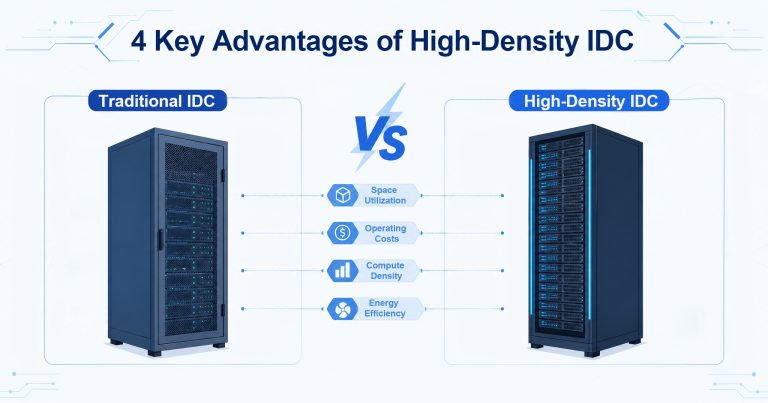
Compared with traditional data centers, deploying High-Density IDC can provide enterprises with greater competitiveness in the market:
| Traditional IDC | High-Density IDC | |
|---|---|---|
| Space Utilization | Larger footprint with more dispersed infrastructure | Rack utilization can increase by 200%–300%, helping conserve valuable data center space |
| Operating Expense (OPEX) | High expansion costs and greater energy waste | Centralized infrastructure management can reduce deployment and operational costs per unit of computing power |
| Computing Density | Limited by the maximum power capacity of individual racks | Provides several times the computing performance within the same physical footprint |
| Power Usage Effectiveness (PUE) | Traditional air cooling is less efficient, resulting in higher PUE | Combining liquid cooling or precision cooling can significantly improve energy efficiency |
The key advantage of high-density IDC is its ability to provide powerful computing capacity within a limited geographical footprint while potentially reducing overall Total Cost of Ownership (TCO).
3 Key Requirements for Deploying High-Density IDC
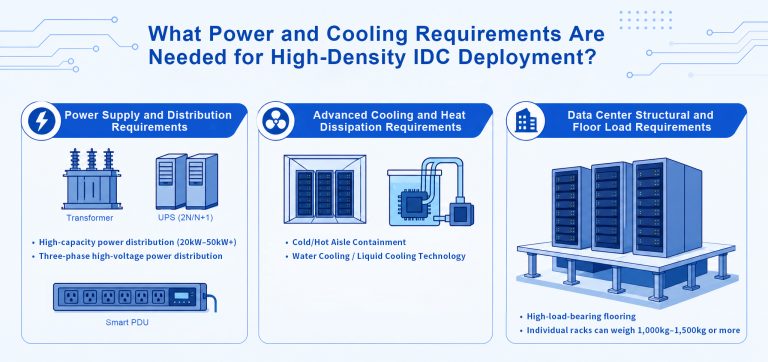
To achieve stable high-density operations, data center infrastructure must be comprehensively upgraded. This includes improvements to power distribution, cooling systems and data center structural requirements. The following are three key requirements for high-density IDC deployment.
1. Power Supply and Distribution Requirements
- High-capacity power distribution: With rack power requirements reaching 20kW–50kW+, data centers require high-capacity transformers and dual-path (2N/N+1) Uninterruptible Power Supply (UPS) systems.
- Three-phase high-voltage power distribution: Three-phase power and intelligent Power Distribution Units (PDU) can reduce the amount of cabling required while improving phase balancing.
2. Advanced Cooling and Heat Dissipation Requirements
Traditional air cooling can approach its thermal limits when rack densities exceed approximately 15kW–20kW, potentially resulting in localized hotspots. High-density IDC environments therefore require advanced cooling solutions such as:
- Aisle Containment: Separating cold and hot air prevents air mixing and improves the efficiency of air cooling systems.
- Liquid Cooling: Technologies such as Immersion Cooling and Direct-to-Chip Liquid Cooling offer significantly higher heat transfer efficiency than air cooling, making them suitable for high-density AI and HPC workloads.
3. Data Center Structure and Floor Loading Requirements
- High-load-bearing floors: High-density racks integrate large numbers of servers, heavy UPS equipment and power distribution modules. Individual racks can weigh 1,000kg–1,500kg or more, meaning the building structure must provide sufficient Floor Loading Capacity to safely support the equipment.
Understand High-Density IDC and Gain a Competitive Edge
As the AI era continues to accelerate, data centers have become critical computing engines for enterprise innovation. Understanding the definition, applications, advantages and requirements of high-density IDC is essential knowledge for modern IT architects and enterprise decision-makers when planning and upgrading data center infrastructure.
Newtech provides professional one-stop data center infrastructure solutions, covering high-density IDC planning and design, power distribution and liquid cooling system deployment, as well as green data center development. From understanding the fundamentals of high-density IDC to implementing high-performance infrastructure, Newtech helps enterprises address the challenges of the high-computing-power era with greater confidence.